
Leung, Preston
Associations of Functional Human Leucocyte Antigen Class I Groups with HIV Viral Load in a Heterogeneous Cohort
Zucco, Adrian G.
, Bennedbæk, Marc
, Ekenberg, Christina
, Gabrielaite, Migle
, Leung, Preston
, Polizzotto, Mark N.
, Kan, Virginia
, Murray, Daniel D.
, Lundgren, Jens D.
, MacPherson, Cameron R.
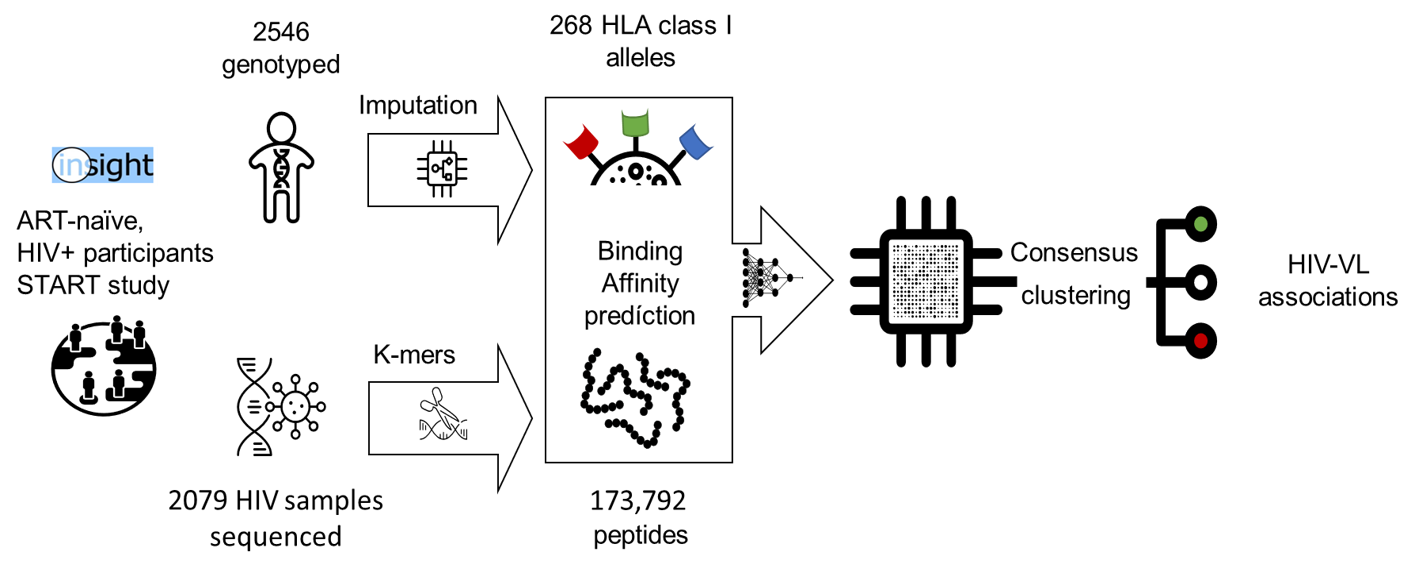
Objective:~ Human leucocyte antigen (HLA) class I alleles are the main host genetic factors involved in controlling HIV-1 viral load (VL). Nevertheless, HLA diversity has proven a significant challenge in association studies. We assessed how accounting for binding affinities of HLA class I alleles to HIV-1 peptides facilitate association testing of HLA with HIV-1 VL in a heterogeneous cohort. Design:~ Cohort from the Strategic Timing of AntiRetroviral Treatment (START) study. Methods:~ We imputed HLA class I alleles from host genetic data (2546 HIV+ participants) and sampled immunopeptidomes from 2079 host-paired viral genomes (targeted amplicon sequencing). We predicted HLA class I binding affinities to HIV-1 and unspecific peptides, grouping alleles into functional clusters through consensus clustering. These functional HLA class I clusters were used to test associations with HIV VL. Results:~ We identified four clades totaling 30 HLA alleles accounting for 11.4% variability in VL. We highlight HLA-B$$57:01 and B$$57:03 as functionally similar but yet overrepresented in distinct ethnic groups, showing when combined a protective association with HIV+ VL (log, $β$ -0.25; adj. P-value $<$ 0.05). We further demonstrate only a slight power reduction when using unspecific immunopeptidomes, facilitating the use of the inferred functional HLA groups in other studies Conclusion:~ The outlined computational approach provides a robust and efficient way to incorporate HLA function and peptide diversity, aiding clinical association studies in heterogeneous cohorts. To facilitate access to the proposed methods and results we provide an interactive application for exploring data.
Association between Ten-Eleven Methylcytosine Dioxygenase 2 Genetic Variation and Viral Load in People with HIV
Murray, Daniel D.
, Grund, Birgit
, MacPherson, Cameron R.
, Ekenberg, Christina
, Zucco, Adrian G.
, Reekie, Joanne
, Dominguez-Dominguez, Lourdes
, Leung, Preston
, Fusco, Dahlene
, Gras, Julien
, Gerstoft, Jan
, Helleberg, Marie
, Borges, Álvaro H.
, Polizzotto, Mark N.
, Lundgren, Jens D.
Introduction:~ Identifying genetic factors that influence HIV-pathogenesis is critical for understanding disease pathways. Previous studies have suggested a role for the human gene ten-eleven methylcytosine dioxygenase 2 (TET2) in modulating HIV-pathogenesis. Methods:~ We assessed whether genetic variation in TET2 was associated with markers of HIV-pathogenesis using both gene level and single nucleotide polymorphism (SNP) level association in 8512 HIV-positive persons across five clinical trial cohorts. Results:~ Variation at both the gene and SNP-level of TET2 was found to be associated with levels of HIV viral load (HIV-VL) consistently in the two cohorts that recruited antiretroviral-naïve participants. The SNPs occurred in two clusters of high linkage disequilibrium (LD), one associated with high HIV-VL and the other low HIV-VL, and were predominantly found in Black participants. Conclusion:~ Genetic variation in TET2 was associated with HIV-VL in two large antiretroviral therapy (ART)-naive clinical trial cohorts. The role of TET2 in HIV-pathogenesis warrants further investigation.